Lifestyle - Published: Monday, April 28th, 2008 5:12 PM CDT
Learning the basics
‘to the tune of a hickory stick’
BY Olga Gize Carlile ocarlile@journalstandard.com
Three cheers for the one-room schoolhouse. It made a difference. It was a
boost, not a handicap.
In 1946, a news/photographic team from
Life magazine came to Pecatonica to do a picture essay on a one-room
schoolhouse.
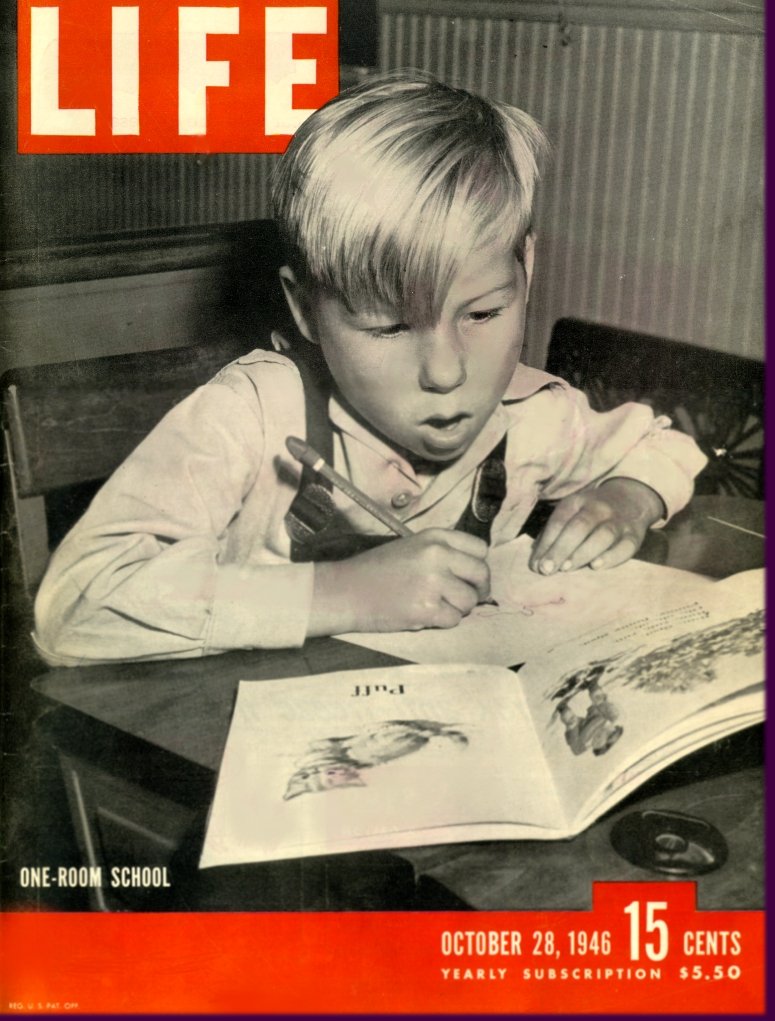 The Buntjer kids n Yvonne and Charles n now 76
and 68, respectively, sent e-mail messages telling what a stellar education they
received in “readin’ and writin’ and ’rithetmic taught to the tune of a
hickory stick.”
The Buntjer kids n Yvonne and Charles n now 76
and 68, respectively, sent e-mail messages telling what a stellar education they
received in “readin’ and writin’ and ’rithetmic taught to the tune of a
hickory stick.”
There was some literary license taken with this photo essay, which Yvonne wanted
to set straight.
“I went to that school,” wrote
Yvonne Buntjer Burt, now of Tucson, Ariz., “and had Miss Myers for a teacher,
the best in the world. I graduated in spring of 1946, and then my brother,
Charles Buntjer, started first grade. He was on the cover of Life magazine. You
can view his world travels at charlesbuntjer.com.”
Also on the Web are their memories of growing up on a farm in Pecatonica. Since
she was 8 when Charles was born, “I put down all the naughty things he has
done.”
School Memories
Yvonne goes on to thank Miss Myers for
all the things she did.
“I was so well educated at the end of eighth grade I could have just forgotten
high school,” she said. “I was so advanced.”
In subsequent e-mails, Yvonne continued to reminisce about her one-room school
days. Before school started in early September, all the mothers came and cleaned
the school.
“The gentleman next door would come
over early in the morning in the winter and start the furnace so we would come
into a warm school,” Yvonne recalled. “In the spring of the last day of
school, we had a picnic for all.”
Yvonne recalls that once a month there were PTA meetings, which were “more
social than anything.”
At these meetings, she said, “We would sing all the good songs, ‘America the
Beautiful,’ etc. The ‘Pledge of Allegiance’ was always recited. There also
was entertainment.”
When Yvonne’s mom was hostess, Yvonne
would often be asked to play the trumpet. Evenings ended with the serving of
dessert and coffee.
The school day was structured a bit different than the magazine essay stated.
“We all went home at 3:30 in the winter, but in the spring and fall at 4 p.m.
But we all left at the same time 1-8 grades.” The essay implied that the
grades were dismissed at different times.
“And the horses were only ridden to
school for Life magazine photographers,” she added.
Life After Life
As for Charles, he found the “Around the Table” column on The
Journal-Standard Web site and enlarged pictures and put in some of his additions
as well.
He also included a picture of himself,
now some 60 plus years later.
“Little did I know that I was to be on the cover of Life magazine.
“And here I am 60-years later, living in San Francisco on the 28th floor of
the Fox Plaza, a high rise in the middle of downtown.
“Can you believe it, all the
schooling I received, during the first formative years in a one-room
schoolhouse, did me a service for which I am thankful for. It gave me the
knowledge to enter the computer field and went from IBM punch cards to setting
up Internet Web sites for major corporations.”
When the story of the one-room schoolhouse appeared in Life magazine in 1946, he
had more than 5,000 people write him, send cards and gifts.
After high school, his mom suggested he apply for a job at Burgess Battery,
where she worked as a secretary. The company sent him to school at IBM, in
Chicago. From there, Charles came in on the ground floor of the birth of the
computer industry and saw the early days of it all.
Charles is a fascinating man to talk to on the phone. His Web site is huge.
He’s traveled the world. He’s done it all since his days in that one-room
schoolhouse. After entering the computer industry with IBM cards and tabulation
machines, he ended up running an installation in the Army at the Presidio of San
Francisco. The last 10 years, he has done consulting for major corporations in
the U.S. such as IBM, Schwab, Y2K Fix for Bank of America and so on.
All of this, said Charles, was possible because of his ability to “speak and
conceptualize information picked up in classes from a one-room school.”
Olga Gize Carlile is a columnist for The Journal-Standard. She may be reached at ocarlile@journalstandard.com.