

|
|
|
|
I have been to the following cities in Mexico:
| Tijuana | Nogales | Mazatl'an |
Puerto Vallarta |
Mexico City |
Cancun |
M'erida |
San Felipe |
Cabo San Luca |
It seems
I
have an affinity with older women - much older - as I have had experiences in Hong Kong, London, Turkey, Chile, South Africa, Brazil and Mexico City with them,
always
One day in Mexico City I decided to take the subway from the
Zona Rosa District
to the main square where all the government offices and the Presidential Palace are located. When I got off and wandered into the square there must have been 100,000 people there! Hundreds or more of police and military were there with riot gear -
batons, shields and tear gas! I found myself in the middle of a riot as the workers were staging a sit down because the pesos
kept being devalued but the politicians, police and military kept their pay raises intact.
I tried to get away and rushed to the subway station which must have had a thousand people in it. A train came by going my direction and we all rushed on, afraid the riot squad was after us.
The train shot down the tunnel and I was shoved to the rear of the car.
An old Mexican woman in front of me knew I was in trouble and asked me where I was getting off. Zona Rosa Station! She had a cane and was about five foot tall but when we got to the station she smacked her cane around and cleared a path for me.
We rushed out of the subway car and onto an almost empty platform. She gave me a big smile and I said, "Gracias" many times. She got back on the car and away she went. I went back to the hotel looking disheveled and the hotel clerk asked me where I was, after I told him he went pale and said I was lucky to get back in one piece! He said many people are beaten up and thrown in jail even if they hadn't done anything wrong, that's being in the wrong place at the wrong time! At least I have enough sense to flee, stand still or keep my mouth shut depending on the situation. Saying "Yes Sir" or what ever a lot of times helps also even if you think otherwise!
I have visited Mexico City
several times and always had a good time there. Check out an overview of the time I was in Mexico City! Then read on about my many adventures in the Yucatan towns and ruins!
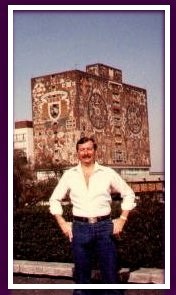 good.
good.
One morning I was having breakfast and there was a women at the next table, nice looking and alone. We struck up a conversation and she said she was from London taking a trip around the world. Had been to Egypt among other places and had been diving in the Bahamas and now Mexico City. As we were chatting a couple at the next table started talking to us. Both of us enjoyed talking so we got them to tell us about themselves. They were farmers from southern Illinois and the husband thought that since it was their 20th wedding anniversary he was going to take his wife on a trip as they had never really done any traveling out of the state. We thought, how nice of him.
Then he said that they had just gotten into Mexico City the day before and spent the afternoon and evening in their room, a little afraid to go out. They ended up watching I Love Lucy but were unhappy because for some strange reason, everyone spoke Spanish! I wonder why?
The woman from London and I decided these two needed help so we decided we were going to see the Pyramid of the Sun and Moon outside of Mexico City. We hired a cab and told them to get with it. At first they felt like they were intruding but off we went. We had a great day climbing over the pyramids and gossiping about where to go next. You have to go to see the Palace of Ferdinand & Isabella, the only Emperor and Empress in the Western Hemesphere and the fantastic museum
containing Indian artifacts, we told them. The next day we were in the park looking at the palace and who was there but the farm couple. They were walking all over enjoying themselves all because we had spent a little time getting them
acclimated to traveling.
Overview of Mexico City
Panoramic view of the Zócalo (Plaza de la Constitución), Mexico City, since the Aztecs, the symbolic center. Looking east to the Palacio Nacional. (center) The Metropolitan Cathedral is on the left, the old city hall to the right.
During the final stage of the Spanish conquest of the Aztecs, Spanish forces besieged and razed Tenochtitlan. Hernán Cortés understood the strategic and symbolic importance of the Aztec capital, founded the Spanish capital of Mexico City on the site, and in particular rebuilt the Aztec ceremonial and political center as the main square, the Plaza Mayor, usually called the Zócalo. Some of the oldest structures in Mexico City date from the early conquest era. Many colonial-era buildings remain standing and have been re-purposed as government buildings and museums. As the seats of the Viceroyalty of New Spain and the Archbishopric of New Spain, Mexico City was the center not only of political and religious institutions but also of Mexico's economic activity and the residence of social elites in colonial Mexico (1521–1821).
Great merchant houses were located here, and the economic elites of the country also lived in the city, even if the sources of their wealth lay elsewhere. The concentration of mansions and palaces in what is now the Mexico City historic center led it to be nicknamed the "City of Palaces", a sobriquet often attributed, perhaps erroneously, to great savant Alexander von Humboldt. It was also a major educational center: the University of Mexico was founded in 1553 as part of the complex of the Plaza Mayor. The crown-approved attempt to train Nahua men to become Christian priests saw the establishment in 1536 of the Colegio de Santa Cruz de Tlatelolco in one of the two sections of the capital governed by a Nahua city council (cabildo). Many religious institutions for the education of the sons of Spanish elites were also based in the capital. Mexico City had the colony's largest concentration of those of Spanish heritage (both Iberian-born peninsulares and American-born criollos), as well as the largest concentration of mixed race casta population in the colony. Many Indians also lived outside the center of the capital.
Ever since independence in 1821, Mexico City remains the country's largest and most important city. Post-independence, U.S. forces captured Mexico City during the Mexican–American War, and the city saw violence during the Reform War and the French Intervention as well as the Mexican Revolution. At the beginning of the 20th century, the city's population stood at about 500,000. The city's history in the 20th and 21st centuries has been marked by explosive population growth and its accompanying problems. The city center deteriorated. The government has had problems keeping up with basic services, but the building of the Mexico City Metro has alleviated some major transportation problems.
Smog became a serious problem as the shanty towns evolved, formed by the poor of the country migrating to the city. Since the 1985 Mexico City earthquake, which caused significant damage to the center of the city, efforts have been made to correct some of these problems. In the 2000s, businessman and philanthropist Carlos Slim created a foundation to revitalize the historic center as well as sites near the Basilica of the Virgin of Guadalupe.
The city now known as Mexico City was founded as Mexico Tenochtitlan in 1324 and a century later became the dominant city-state of the Aztec Triple Alliance, formed in 1430 and composed of Tenochtitlan, Texcoco, and Tlacopan. At its height, Tenochtitlan had enormous temples and palaces, a huge ceremonial center, residences of political, religious, military, and merchants. Its population was estimated at least 100,000 and perhaps as high as 200,000 in 1519 when the Spaniards first saw it.
1983 - Mexico City - Pyramid of the Sun - Buildings in Town!
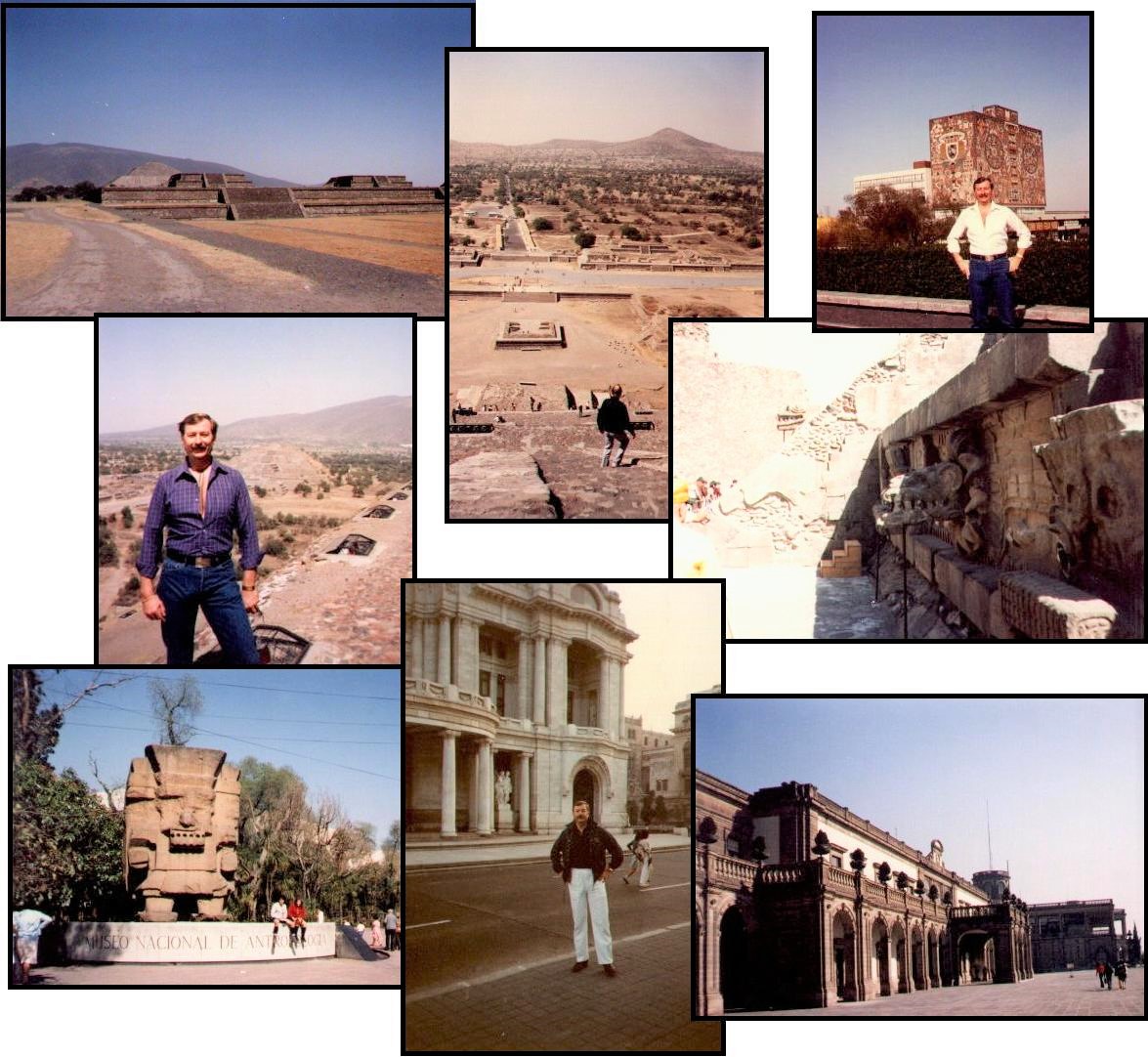
for Mexico.
The area around M'erida
includes Chichen Itza and is one of my favorite areas to explore in Mexico.
Please see the map and the geographical statistics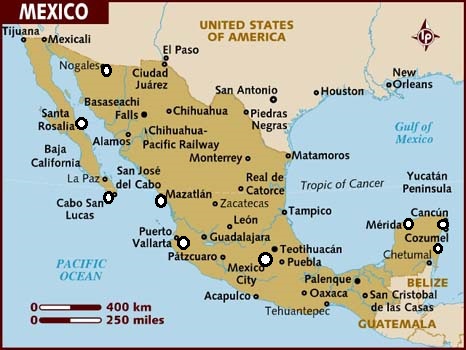
Here I
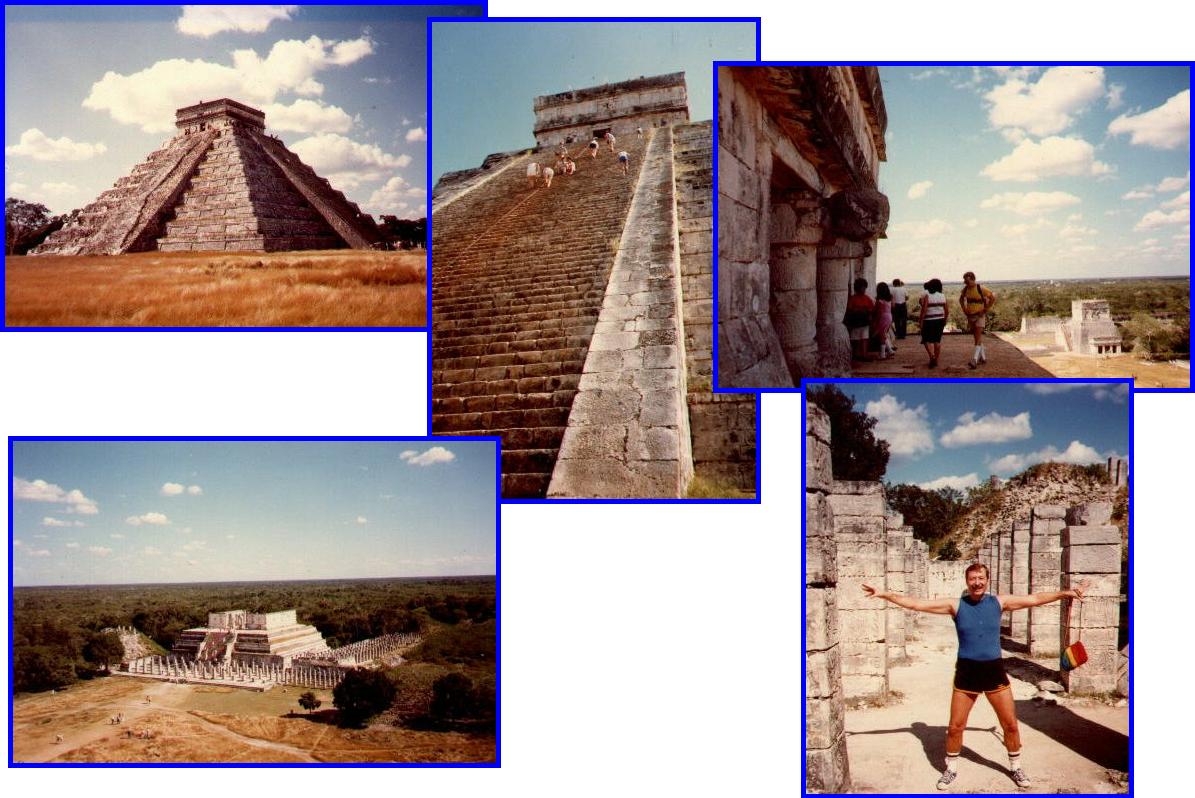
am on top 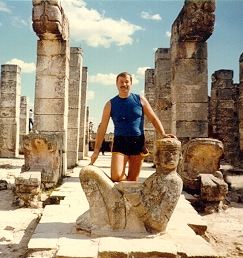 of the main platform of the Temple of the Warriors in Chichen Itza. This is a huge complex and the most important at
Chichen Itza. It also clearly shows the influence of the Toltecs on Yuckatan for
its general arrangement comes from the main temple in Tulum. This was the
sanctuary of Tlahuizcalpantecuhtli dedicated to the Planet Venus as the Morning
Star. This incarnation of Venus was incarnated by Quetzalcoatl.
of the main platform of the Temple of the Warriors in Chichen Itza. This is a huge complex and the most important at
Chichen Itza. It also clearly shows the influence of the Toltecs on Yuckatan for
its general arrangement comes from the main temple in Tulum. This was the
sanctuary of Tlahuizcalpantecuhtli dedicated to the Planet Venus as the Morning
Star. This incarnation of Venus was incarnated by Quetzalcoatl.
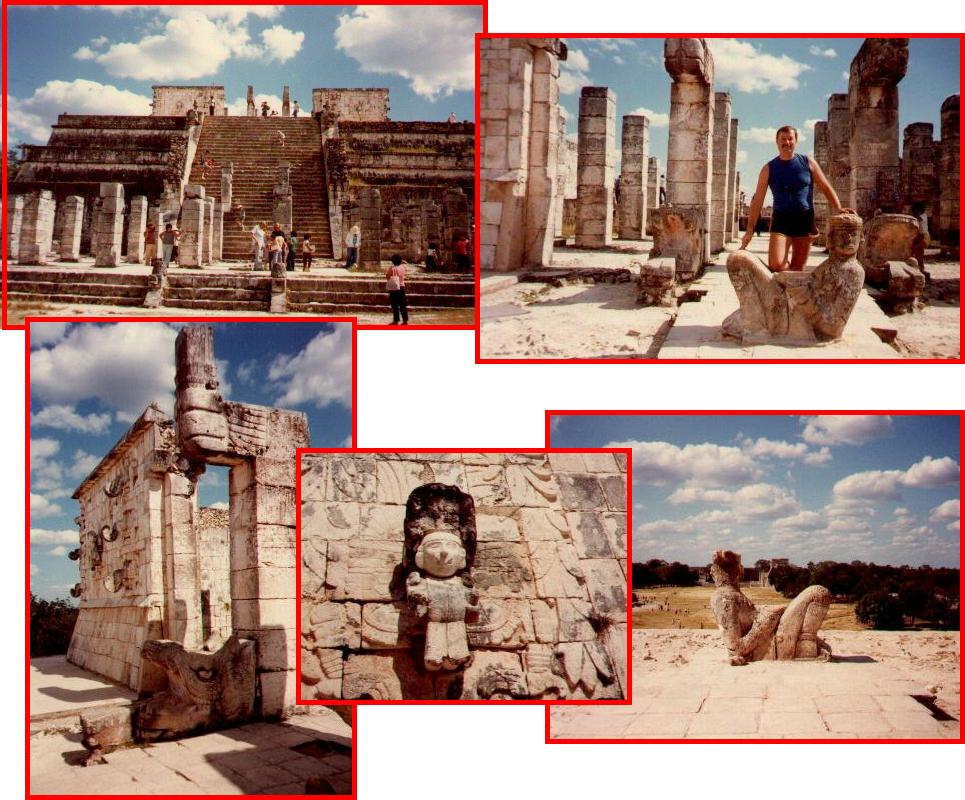
This pyramid was composed of four stepped levels, its sides are covered with relief's that depict the symbols of the orders of Eagles and Jaguars alongside ritual scenes.
At the top of the stairs where I am
standing is the recumbent Chat Mool, his upper body propped up on his elbows,
holds on his belly a plate in which the hearts of sacrificial
victims were placed. The two serpents on each side of me
represent the rattlesnakes whose open jaws, ready to bite, guard the threshold.
Chichén Itzá and Uxmal are the two
most important sites in the Yucatán Peninsula. Chichén Itzá had two periods
of greatness, under the Maya from 600-900 A.D., then again following the arrival
of the warlike Toltecs in the 10th century. For this reason two distinct
architectural styles are visible, one belonging to the Classic-Period Maya, and
the other developed in conjunction with the Toltecs, whose bloody practices were
reflected in the artwork commissioned under them. The site is perceived as
having two parts: Old Chichén (Maya) and New Chichén (Maya-Toltec).
The major structures include the
Castillo or Kukulcán pyramid, sacred connote or well (site of human sacrifice),
the ball court (largest in Mesoamerica, perfect acoustics), Warriors Temple and
the El Caracol observatory. On December 8, 1988, Chichén Itzá was named part
of
UNESCO's "World Heritage" or "Patrimonio Mundial".
We had rented a car and were driving all over the Yucatan peninsula. We followed one of the tour guides at Chichen Itza so we could get a feel for the ruins.
He took the group to a cenote, a natural well formed out of the limestone rock. The rain water runs through the soft rock forming cavities of water and eventually the roof falls in forming these wells.
The Mayan used these wells to irrigate as well as to drop sacrificial "virgins" and gold objects into them to appease the gods. I have better things to do with virgins and golden objects than to throw them away, at least if you can find any.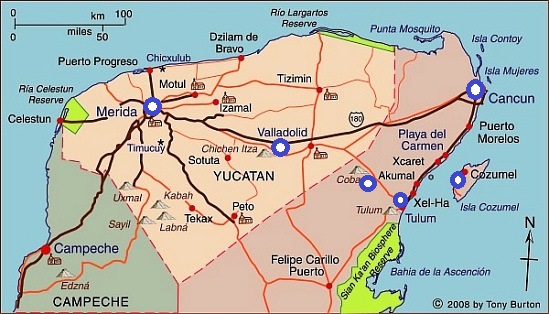
Don't ask me what was going on in my mind but I suddenly lost it. As the guide was telling us about the sacrifices,
this is where the priests used to steam
The guide said that the building originally was a bath house where people were purified before being tossed into the
cenotes and it looked like I was the next sacrifice.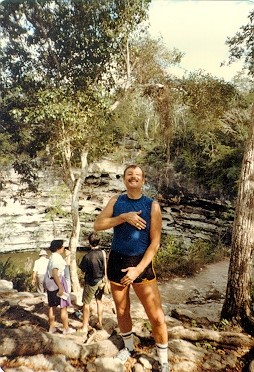 themselves
to cleanse themselves of impurities before cutting out the heart of someone or
throwing them and precious objects into the cenotes. I climbed onto the ruins of a building about 15 feet square and eight feet high and covered my chest and groin with my hands and did the dance of the
Virgins.
Everyone watching cracked up except the person I was with. Jon tried to ignore me. As fate would have it, I tripped and almost fell off of the ruins into the
cenotes.
themselves
to cleanse themselves of impurities before cutting out the heart of someone or
throwing them and precious objects into the cenotes. I climbed onto the ruins of a building about 15 feet square and eight feet high and covered my chest and groin with my hands and did the dance of the
Virgins.
Everyone watching cracked up except the person I was with. Jon tried to ignore me. As fate would have it, I tripped and almost fell off of the ruins into the
cenotes.
It is no accident that the rain god has been given such a prominant place in the Yucatan. There are no rivers and the cenotes were used to store rain water to be used in the dry season. Being underground, the caves or cenotes are mysterious and dark and were important parts of the religious services when sacrificing the virgins, young men and women and golden objects.
My friend Jon,
who traveled with me on this trip said, "Leave it to Chuck to find a bath house in the middle of no where!"
I decided it was time to come down from the ruins because even if I fell into the sacred well, I wasn't a virgin so it would be a waste of good talent!
We also went to Tulum to see ruins that are fantastic and
only a short two hour drive from Cancun.
Overview of El Castillo Pyramid!
Built by the pre-Columbian Maya civilization sometime between the 8th and 12th centuries AD, the pyramid served as a temple to the deity Kukulcán, the Yucatec Maya Feathered Serpent deity closely related to Quetzalcoatl, a deity known to the Aztecs and other central Mexican cultures of the Postclassic period. It has a substructure that likely was constructed several centuries earlier for the same purpose.
The pyramid consists of a series of square terraces with stairways up each of the four sides to the temple on top. Sculptures of plumed serpents run down the sides of the northern balustrade. Around the spring and autumn equinoxes, the late afternoon sun strikes off the northwest corner of the pyramid and casts a series of triangular shadows against the northwest balustrade, creating the illusion of the feathered serpent "crawling" down the pyramid. To contemporary visitors, the event has been very popular and is witnessed by thousands at the spring equinox, but it is not known whether the phenomenon is a result of a purposeful design since the light-and-shadow effect can be observed without major changes during several weeks near the equinoxes.
All four sides of the pyramid have approximately 91 steps which, when added together and including the temple platform on top as the final "step", may produce a total of 365 steps (the steps on the south side of the pyramid are eroded). That number is equal to the number of days of the Haab' year and likely is significantly related to rituals.
The structure is 24 m (79 ft) high, plus an additional 6 m (20 ft) for the temple at the top. The square base measures 55.3 m (181 ft) across
El Castillo!
Overview of theTemple of the Warriors!
Here I am on top of the Temple of the
Warriors. This is a huge complex and the most important at Chichen Itza. It also clearly shows the influence of the Toltecs on Yuckatan for its general arrangement comes from the main temple in Tulum. This was the sanctuary of Tlahuizcalpantecuhtli dedicated to the Planet Venus as the Morning Star. This incanation of Venus was incarnated by Quetzalcoatl.
This pyramid was composed of four stepped levels, its sides are covered with reliefs that depict the symbols of the orders of Eagles and Jaguars alongside ritual scenes.
At the top of the stairs where I am standing is the recumbant Chat Mool, his upper body propped up on his elbows, holds on his belly a plate in which the hearts of sacrificial victims were placed.
The two serpents on each side of me represent the rattlesnakes whose open jaws, ready to bite, guard the threshold.
Chichén Itzá and Uxmal are the two most important sites in the Yucatán Peninsula. Chichén Itzá had two periods of greatness, under the Maya from 600-900 A.D., then again following the arrival of the warlike Toltecs in the 10th century. For this reason two distinct architectural styles are visible, one belonging to the Classic-Period Maya, and the other developed in conjunction with the Toltecs, whose bloody practices were reflected in the artwork commissioned under them. The site is perceived as having two parts: Old Chichén (Maya) and New Chichén (Maya-Toltec).
The major structures include the Castillo or Kukulcán pyramid, sacred cenote or well (site of human sacrifice), the ball court (largest in Mesoamerica, perfect acoustics), Warriors Temple and the El Caracol observatory. On December 8, 1988, Chichén Itzá was named part of UNESCO's "World Heritage" or "Patrimonio Mundial".
Temple of the Warriors!
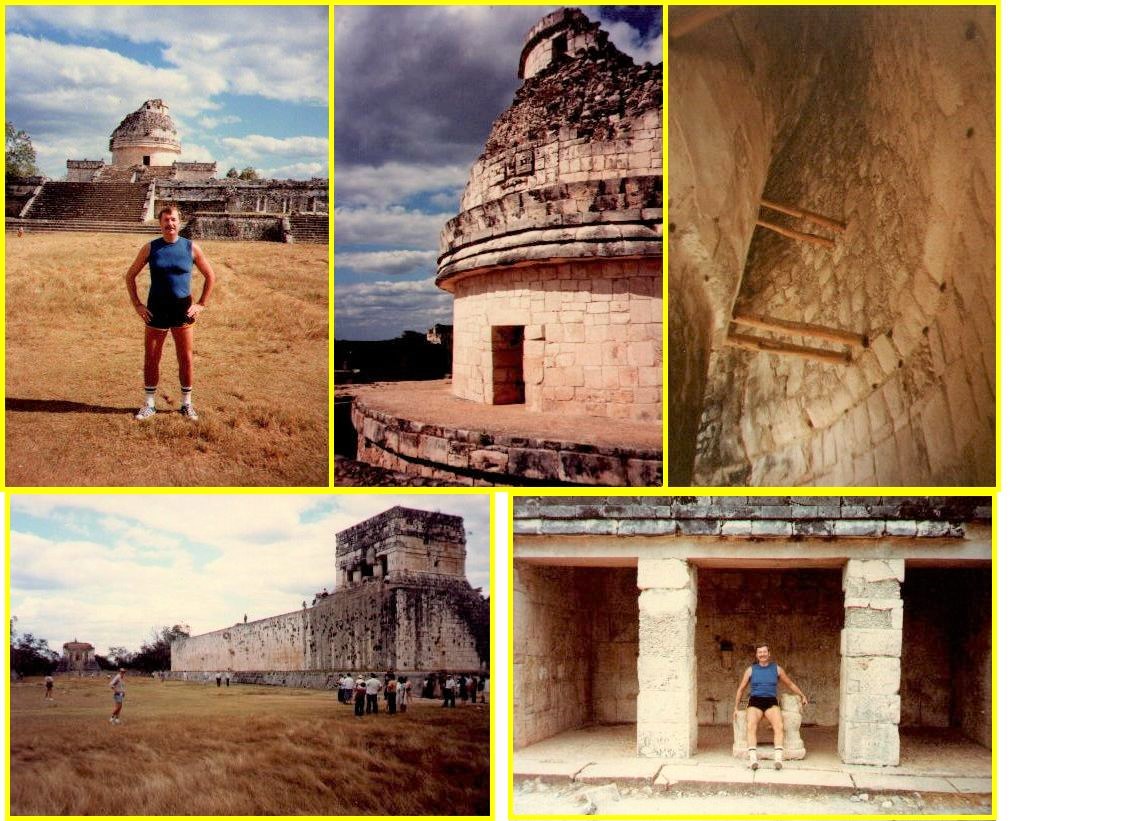
Overview of the El Caracol Observatory
The structure is dated to around AD 906, the Post Classic period of Mesoamerican chronology, by the stele on the Upper Platform.
It is suggested that the El Caracol was an ancient Mayan observatory building and provided a way for the Mayan people to observe changes in the sky due to the flattened landscape of the Yucatán with no natural markers for this function around Chichen Itza. The observers could view the sky above the vegetation on the Yucatán Peninsula without any obstruction.
Mayan astronomers knew from naked-eye observations that Venus appeared on the western and disappeared on the eastern horizons at different times in the year, and that it took 584 days to complete one cycle.
They also knew that five of these Venus cycles equaled eight solar years. Venus would therefore make an appearance at the northerly and southerly extremes at eight-year intervals.
Of 29 possible astronomical events (eclipses, equinoxes, solstices, etc.) believed to be of interest to the Mesoamerican residents of Chichén Itzá, sight lines for 20 can be found in the structure. Since a portion of the tower resting on El Caracol has been lost, it is possible that other observations will never be ascertained.
The El Caracol Observatory and Ball Park
History of Tulum
Tulum means fence, trench or wall, and is the name given to the site in recent times because of the wall surrounding it, although its ancient name was possibly
In Juan de Reigosa's Las Relaciones de Yucatan, written in 1579, Zama is mentioned as a walled site with stone buildings which included a very large one that looked like a fortress. Pedro Sanchez de Aguilar, author of Informe Contra Idolorum Cultores del Obispado de Yucatan, (Madrid, 1639) mentions the coast of Zama when telling the story of ten shipwrecked Spaniards who were taken prisoner by the chieftain Kenich. Among them was Geronimo de Aguilar, who later became Hernan Cortes' interpreter during the Conquest of Mexico.
After this there are no other references to Tulum until Juan Pio Perez in a letter dated 1840 says that Juan Jose Galvez had visited Ascencion Bay, discovering that between there and Cape Catoche there were two ancient cities, Tancah and Tulum, the latter surrounded by walls.
In 1842, John L. Stephens and Frederick Catherwood visited tho site and later made it known to the world with the book Incidents of Travel in Yucatan, where Stephen's text is complemented by Catherwood's magnificent illustrations. During the Maya uprising of the War for the Castes, which began in 1847 and lasted until 1901, Tulum was occupied several times by rebels because of the protection its wall afforded. In 1871 it became one of the sanctuaries of the "Speaking Cross" cult, led by the Indian woman Maria Uicab, who was known as the patron saint or queen of
Tulumn.
Several expeditions reached Tulum later. In 1895, W. H. Holmes made two drawings of the area from his yacht, and in 1913 Sylvanus G. Morley and J.L. Nussbaum paid a short visit to the site.
The Carnegie Institution of Washington organized expeditions in 1916, 1918 and 1922 led by Morley and including other noted researchers. In 1937, members of the Mexican Scientific Expedition studied various sites on the east coast of the Yucatan peninsula, including Tulum. The following year Miguel Angel Fernandez began the work of restoring and in investigating the site. Finally, the National Institute of Anthropology and History, through the Southeast Regional Center is continuing investigation and maintenance of this important Maya archaeological site.
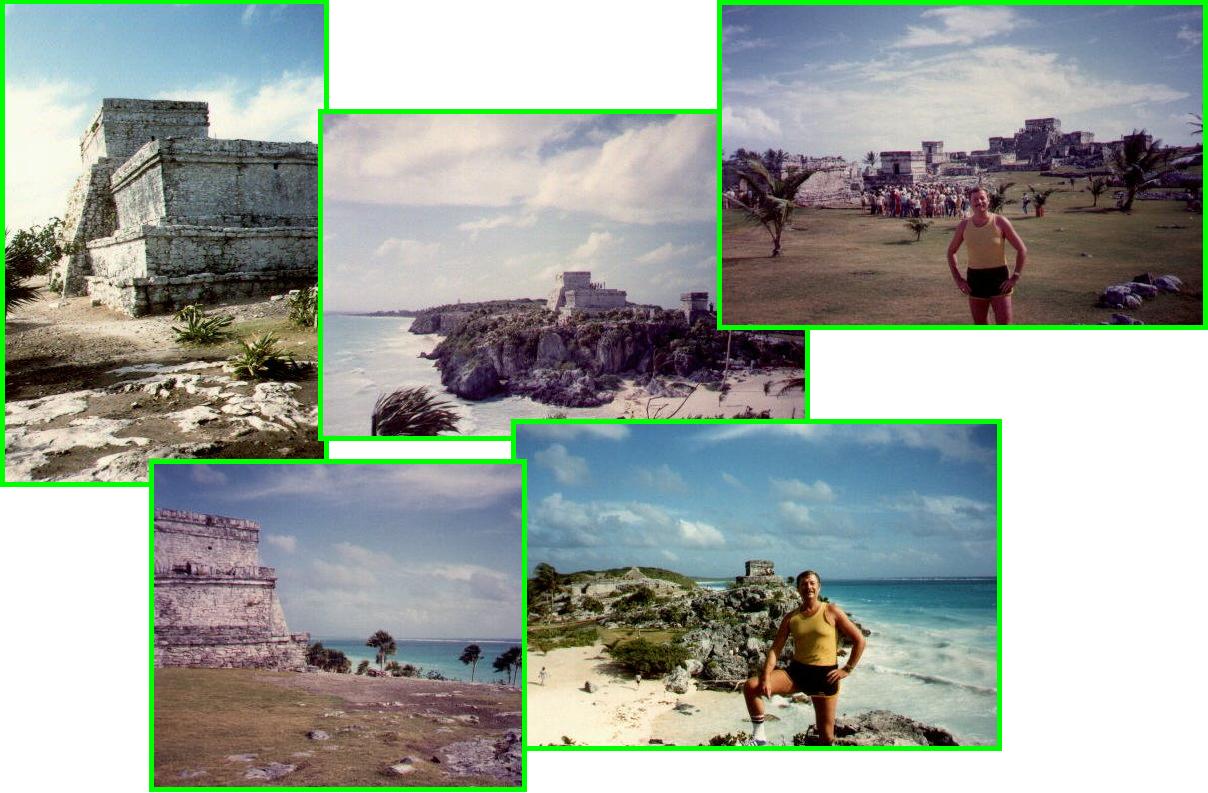
Tulum Photos
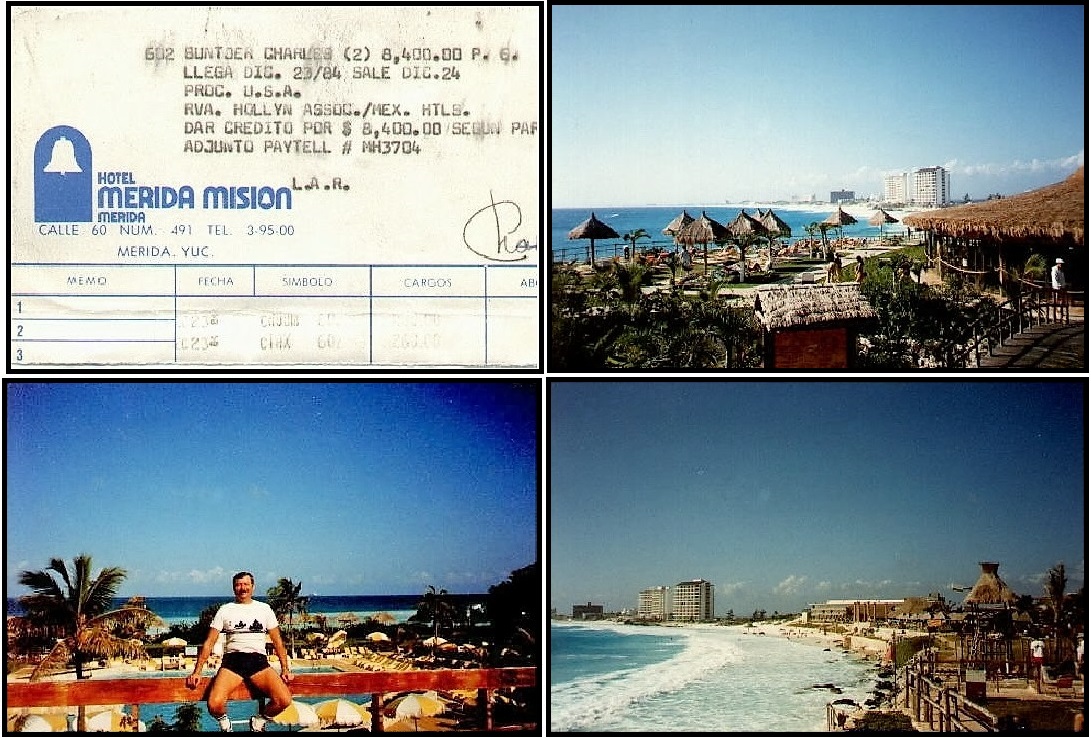
Overview of Cancun - 1987
Before Cancun became a tourist town and before the Spanish occupation, the Yucatan Peninsula was inhabited and dominated by Mayan civilizations until most of the local sites were abandoned by the15th century. For centuries, this region was mostly wetlands, mangroves, jungles, and virgin beaches. The Maya originally called the area “Kan Kun” meaning den of snakes, golden serpent, and abundant low-lying areas, which later evolved into “Can Cun” by the Spanish.
Cancun - Tourist Resort Town
It wasn't until 1968 when the Mexican government recognized the potential of this strip of land or peninsula - known as Cancun island - between Nichupte Lagoon and the Caribbean Sea to grow into a popular tourist destination. Development began immediately, establishing a connection between Cancun island and the Cancun mainland.
Cancun
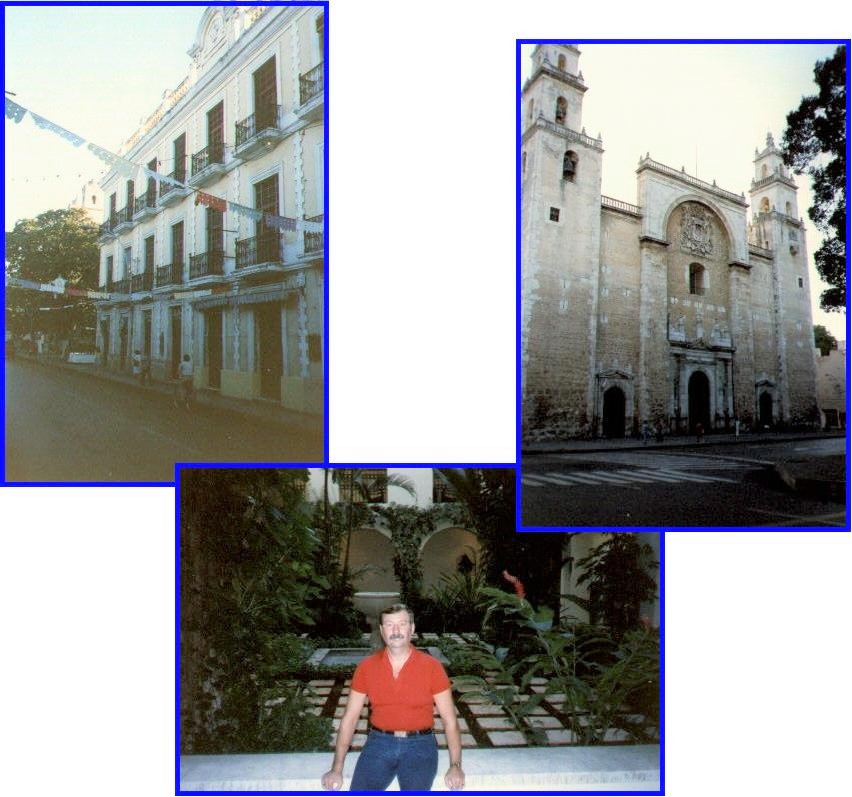
Overview of Merida - Capital of the Yucatan
According to the 2015 census, the population of Mérida was 892,363, ranking 14th among the most populous Mexican cities. The Greater Mérida metropolitan area includes the municipalities of Mérida, Umán and Kanasín and had a population of 1,035,238 in the 2010 census. The municipality's area is 858.41 km2 (331.43 sq mi). Among the four cities that share the same name around the world, it is the largest - the other three being in Spain, Venezuela, and the Philippines.
The city, like much of the state, has heavy Mayan, Spanish, French, British, Lebanese and to a lesser extent Dutch influences. Mérida has the highest percentage of indigenous population within any large city in Mexico. The Maya are approximately 60% of the population.
Merida
Lots of stories about the trip!
Note:
Some of the situations that are described below might be of use when you travel and get into bad situations. At least you can always laugh about it after the fact!
San Francisco Air Port
This trip to Mexico was one of those that try the patients of people and luckily I had traveled enough to be ready for it even if my traveling companion wasn't. It of course, started out with Mexicanna Airlines. We boarded around noon in San Francisco and the plane was full as it was the week before Christmas and everyone that lived in Mexico City or were vacationing were on the plane. We sat there for an hour and asked what was happening. The captain came on the horn and said that there were three 'important' people that wanted to go to Mexico, politicians and who knows whom else. They would offer a $100 and a later flight but no guarantee as to when that flight might be. A $100, give us a break. We were still there three hours later and the passengers were pissed and started yelling, "Get this sucker off the ground." We finally took off with the three 'important' people still waiting for a seat to Mexico.
Mexico City
So we stop in Puerto Vallarta and then to Mexico City which means we missed the flight to Cancun, the next flight to Cancun was 18 hours away. The airlines said they would give us a hotel room in the Holiday Inn at the end of the runway.
"No way Jose", I said. I want a room at the Presidente del Prado in downtown Mexico, meals and a chit for a taxi. So off we went to the hotel and Jon was impressed. He got to see a little of Mexico City, the Opera House, House of Tiles, and a Christmas festival in the square across the street.
Cancun - Car and Hotel!
Well the next day we took off to Cancun and after landing the car agent said we were a day late. I said I had asked Mexicanna to wire them and the hotel that we would be a day late because of their idiotic delay in San Francisco. I threw a fit and we got a brand new Volkswagen that was built in Brazil. Nifty! Off to Cancun and the hotel.
You know what had to happen next, the hotel manager said there was "No room at the Inn!" It is Christmas and all the rooms are rented and you are a day late, tuff luck. Jon looked faint and I was pissed, asked if Mexicanna had called them. They didn't think so. While they were giving me a hard time I looked over the counter and saw a computer listing and there was my name. I almost jumped over the counter and pointed my finger at my name. I said,, "Don't give me that crap, there is my name and the payment and the room number." The hotel clerk really was shook up. Yeah, like rebook the room and get two payments for the same time period. So off to our hotel room and finally settling in to begin our vacation!
On the Road to Merida
Jon hadn't done much traveling and I indicated as we were driving to Merida that it was wise to keep one's mouth shut when confronted by the military or police. As we got to the border of Quintanna Rou and the Yucatan states, the military stopped us, about 30 soldiers all looking about 18 with machine guns. Once put the muzzle on the windowsill and slid it around and asked where we were staying and where we were gong. Of course a tour bus with a 100 people went flying by without being stopped. So I told him the information and Jon was fidgeting around looking grumpy. Great! So next the soldier asked if we were carrying any fruit like coconuts. I went to say "No" and what do I hear from the peanut gallery:
"The only coconuts in this car are between my legs!"
I was mad and said, "Keep quiet or you will be walking to Merida and I don't think you want that." The soldier asked what did Jon say and I smiled nicely and said we didn't have any contraband in the car, anyway the car was licensed in Mexico so I wasn't worried about that.
Merida
We finally made it to Merida and we just loved the city an old Spanish town and people were friendly. We got into town and couldn't find the hotel. The streets were all one way and we went around the same area about six times. It was funny and aggravating at the same time. We finally asked someone if they knew where the hotel was as they said, "Right across the street." We still had trouble getting to it the way the street signs were laid out. We went to Christmas mass in their beautiful cathedral and enjoyed just walking around.
Chechen Itza
Off to Chechen Itza and we did have several experiences, one which affected Jon. He was acting up at the pyramid and I was walking up the steps to take some pictures at the top. Jon was doing his impersonation of Carmen Miranda and wished he had those big wedgies on and a big feather hat like the Mayan priest.
There is a big iron chain that hangs from the top of the steps to the bottom, the pyramid must be about six stories tall. Jon got about 10 steps up and I was standing about 40 feet up and turned and told him not to look down because he might get dizzier than usual. He didn't like that remark so he grunted and then looked down. His eyes whirled around and he grabbed the chain and that was all Carmen Miranda wrote! I told him it was a good thing that this happened down there because he would have been in trouble if he got to the top because I was not going to carry him down. We still laugh about that and figured the priests took all those hallucinatory drugs just to get up those sharp, steep steps on the pyramids.
Return trip!
The rest of the vacation was great until we left Cancun. Naturally Mexicanna Airlines was four hours late to Cancun. Everyone was mad, they locked us in the airport lounge and one couple from San Jose, a professional couple, asked the airport personnel what was happen. They said, "No comprende!" The couple then told them off in Spanish because they were originally from Mexico. Finally the plane came and off to Mexico City. There we changed planes and off to San Francisco. Wait a minute, why are we landing in Quatalahara? They made us get off the plane and drove us to the airport and made us pay the airport tax again. Everyone was mad. Then we were told by a woman that the plane was over booked and when they opened the door, to rush to the plane and get our original seats. I flew like the wind and got my window seat. A man and his wife, Mexican, told me I was in their seats. I showed them my ticket and told them what had happened so far. They shook their heads, that sound normal they said. Just stay there, we will grab some other seats. There was almost a riot, anyone in a seat just hung on! The back of the plane was full of illegal immigrants and all they talked about was how to get past the immigration counter at the airport. Maybe some one can explain how I as a citizen have my passport checked and rechecked and these people work in the US and then go back to Mexico for the holidays and come back in through the airport and not get caught?
San Francisco!
Finally we got back to the City and we kissed the ground. So good to be home! This was the second most horrible experience I have ever had when flying. The other was Olympic Airlines, Greek, as you can read about on my web pages on Greece and Egypt.
El Castillo (Spanish pronunciation: [el kas'ti?o], Spanish for "the castle"), known as the Temple of Kukulcán (or also just as Kukulcán), is a Mesoamerican step-pyramid that dominates the center of the Chichen Itza archaeological site in the Mexican state of Yucatán. The pyramid building is more formally designated by archaeologists as Chichen Itza Structure 5B18.
El Caracol, the Observatory, is a unique structure at pre-Columbian Maya
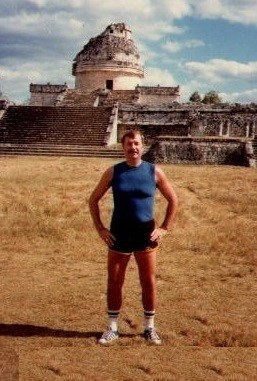 civilization site of Chichen Itza. El Caracol, which means 'snail' in Spanish, is so named due to the spiral staircase inside the tower.
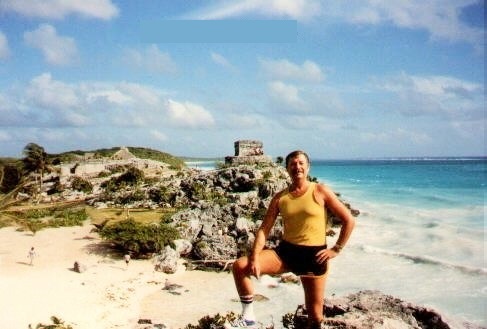
Here's Chuck
along the Atlantic coast and in front of the ruins of
Tulum, one of the few Mayan ruins situated on the cliffs overlooking the ocean.
 Zama, a corruption of Zamal (morning), associated with the dawn. This is an ideal name for the site, as sunrise in Tulumis a superb sight.
The first mention of this city was made by Juan Diaz, who was on Juan de Grijalva's expedition that reached the coast of the Yucatan peninsula in 1518. He wrote, "We followed the coast day and night; on the following day... we sighted a city or town so large that Seville would not have appeared bigger or better... a very tall tower was to be seen there..." which no doubt refers to Tulum and the building known as the Castle, standing on the edge of the cliff.
Zama, a corruption of Zamal (morning), associated with the dawn. This is an ideal name for the site, as sunrise in Tulumis a superb sight.
The first mention of this city was made by Juan Diaz, who was on Juan de Grijalva's expedition that reached the coast of the Yucatan peninsula in 1518. He wrote, "We followed the coast day and night; on the following day... we sighted a city or town so large that Seville would not have appeared bigger or better... a very tall tower was to be seen there..." which no doubt refers to Tulum and the building known as the Castle, standing on the edge of the cliff.
Cancun before Cancun
Mérida is the capital and largest city in Yucatan state in Mexico, as well as the largest city of the Yucatán Peninsula. The city is located in the northwest part of the state, about 35 kilometres (22 miles) off the coast of the Gulf of Mexico. The city is also the municipal seat of the Municipality of Mérida, which includes the city and the areas around it.
San Francisco California

Created on:
1980
Updated on:
2020.11.08